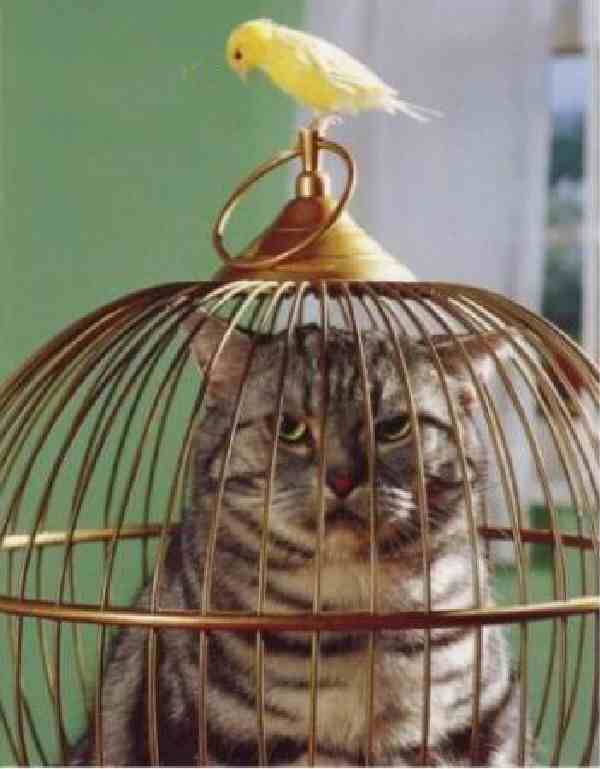
Cat in Cage

"Something's wrong here."
. . . . . . . . . . . . . . . . . .
Funny Animal Photos

Yowie Takes a Dog in Darwin

Australia's Bigfoot, the Yowie, has been causing problems. It seems it has taken and killed a dog. This has happened in Darwin. The owner of the seven-month old puppy says the head was ripped from its body. At first he thought it was done by dingoes. But a researcher, Andrew McGinn, says it was done by a hairy ape-like beast, a Yowie.

Goat owners in this area have seen their animals decapitated by a tall hairy creature for a hundred years, he says. It is a typical Yowie kill. A local woman saw a hairy humanoid in August 1997. Photographs of footprints were taken the next day.

If the Australian Yowie exists it is certainly very secretive. For hundreds of year there have been sightings. Yet no real evidence has been left, apart from footprints which can be made by anyone.
. . . . . . . . . . . . . . . . . .
Society

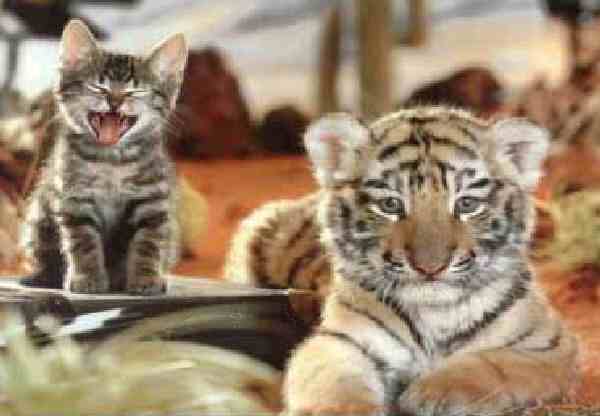
Cat Tiger

"When I grow up, I wanna be a tiger."
. . . . . . . . . . . . . . . . . .
Funny Animal Photos

Felons With Guns Are Percieved as Being Larger

Though widely accepted in law courts it is well known that witness evidence is suspect.  Even victims in many cases get it wrong.  A querk in humans beings is the ability to identify members of one's own race, for the most part, but the noticable inability to recognize people of other races.  The phrase "you all look alike" is relevant here.

What people see can be distorted by a felon carrying a weapon.  Human perception is still based on how our ancestors saw danger.  An opponent carrying a weapon was more dangerous so was perceived as being big and strong.

A current study shows that a witness describing someone with a gun said the gun carrier was larger and taller than he/she actually was.  This brings into question prevailing theories on memory.  Could a person be seen as being bigger if more aggression was shown without a weapon?
. . . . . . . . . . . . . . . . . .
Society

Rabbit Joke

"Ah, ah,ah. Ah,ah,ah. What a joke!"
. . . . . . . . . . . . . . . . . .
Funny Animal Photos

Society and High Intelligence Go Together

We have large brains due to social interaction.  In early societies culture meant things had to be remembered.  Another important function leading to large brains was tools use, though chimpanzees use tools.  The most intelligent people would inevitably become leaders and have the choice of mates, thus passing on their genes.

Intelligence and brain size are of course interdependent.  Animals such as dolphins and elephants have social structures.  They are also very intelligent.  Higher intelligence appears to be naturally selected for in any species.

Apparently, when society develops intelligence must increase otherwise an individual will be "put upon" by the smarter ones.  There is some evidence that really clever individuals tend to be disruptive to a society.  The naive are certainly at a disadvantage.

A thorn in the side of the above theory is that some highly structured societies are composed of small creatures with tiny brains.  Ants, bees and wasps are in this category.
. . . . . . . . . . . . . . . . . .
Society

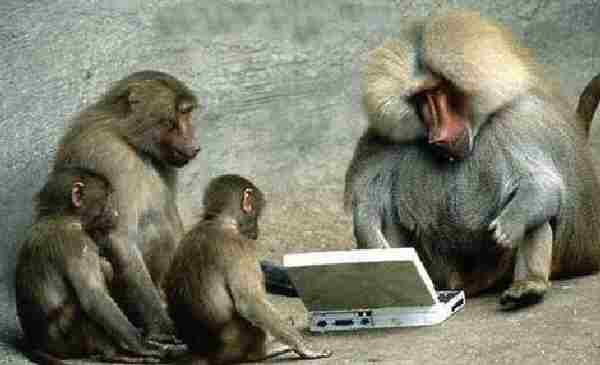
Baboons Test New Computer


"I'm telling you. Read the handbook!"
. . . . . . . . . . . . . . . . . .
Funny Animal Photos

Cane Toads Are Killing off Saltwater Crocodiles

You Don't have to be big to kill a crocodile. A small imported pest can kill one. Cane toads are in plague proportions in the Northern Territory.

Cane toads have poisonous sacks on their heads. When a saltwater crocodile eats one assuming it to be a tasty snack the crocodile ingests the poison and dies.

The problem is so serious that the population has fallen by half in some areas. Because the species takes a long time to breed up numbers, the crocodiles could become very scarce in some regions.

Introducing cane toads was a great mistake by Australian scientists. They were brought in to combat beetles destroying sugar crops in 1935. But the toads ignored the beetles and now threaten many native species by eating what they eat. To travel faster around the country some toads have developed larger hind legs to cover a greater distance before the sun goes down.
. . . . . . . . . . . . . . . . . .
Society

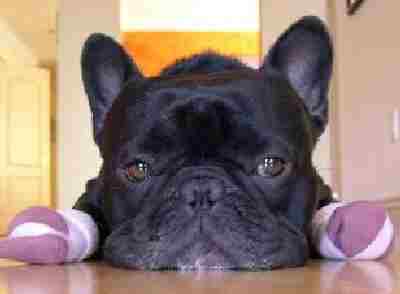
Bored Dog

"Ho hum! What a day."
. . . . . . . . . . . . . . . .

Man Tortures Kangaroo

Culling an animal species is acceptable but cruelty is not.  The exact population of kangaroos in unknown.  There are at least as many as there are people in Australia.

Culling involves a direct gunshot to the head.   Using your car as a weapon to run over a kangaroo, then kicking it to death is definitely not on.

Nigel Franks went even further: he dragged the carcass two kilometers along the road with a rope attached to his car.   A woman found the dead animal in the high street of a town.

In court the defendant was told he was in serious trouble.  He had already broken the law before, not complying to a community order.  He has to return to court on June 4 to find out what his sentence will be.
. . . . . . . . . . . . . . . . . .
Law

Dog and Cat Who-Done-It


"Alright! Who did it?"
. . . . . . . . . . . . . . . . . .
Funny Animal Photos

Housing Not Affordable for the Young

The concept of building one and two bedroom houses instead of the traditional three and four bedroom homes seems doomed to failure.  More adult children than ever are going back home to live with their parents.  A single person simply cannot earn enough  to get a loan for a house.  If you are a labourer or a TAFE trained worker this is  increasingly the case.  As many as 70 per cent of people aged under 35 cannot buy a  home of their own.

While specialists say tax incentives are needed to enable young people to buy, this is not the problem.  Australia will have a housing shortage for decades because there are  not enough qualified builders in outback Australia.  This is particularly the case in  booming Western Australia with mineral companies being forced to have accommodation  built at great cost.

Giving the young tax breaks and just giving them handouts is not a solution.  It is a  bottom up issue not a top down problem.  Getting trades persons from other countries will not make any difference either.  Countries have unique building codes.  For  example, in the UK houses are built in double brick where the two walls hold up the roof.  In the US they built much larger houses.  In Australia brick veneer is the norm  where timber holds up the roof and bricks are just decoration.

The next Australian government will probably be Liberal/National. They will not be inclined to give handouts.  Moreover, with the push toward a balanced budget next year the current Labor government has no money to spare.
~~~~~Society~~~~~
. . . . . . . . . . . . . . . . . .

Cat on Throne

"Just 'Your Majesty' will do."
. . . . . . . . . . . . . . . . . .
Funny Animal Photos

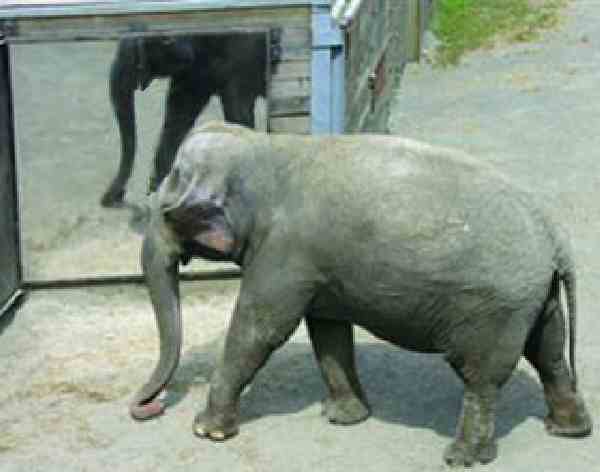
Elephant Looks in the Mirror

"Mirror, mirror on the wall, who's the fairest of them all?"
. . . . . . . . . . . . . . . . . .
Funny Animal Photos

Campaign To End Sale of Battery Eggs

Environmentalists launch a campaign to stop the sale of battery eggs.  This involves "pestering" consumers in supermarkets who are about to buy battery eggs.  The environmentalist will not win the war.  They will just make consumers angry.  Radio advertisements will have the same effect.
If battery eggs are banned the price of supermarket eggs will increase from $2.50 to $10.00 a dozen.  The government will also have the burden of compensation for battery farms which are forced to close.

The campaigners believe that consumers need to be educated about chickens living in tiny pens.  People already know this.  They don't need to be force-fed the truth.  They also know that cows must be kept alive for blood to be drained from the body after they are knocked out.  This doesn't stop them buying beef.

European countries are trying to change, but the supply of free-range eggs is insufficient to meet demand.  Not enough businesses are prepared to re-invest in bigger cages.  Furthermore, a recent university study showed that battery hens were not stressed.
. . . . . . . . . . . . . . . . . .
Society